

How Do Conflict Theorists Explain The Makeup Of Prisoners In The U.s. Prison System?
Conflict Theory
Conflict theory looks to social and economical factors equally the causes of crime and deviance. Dissimilar functionalists, conflict theorists don't see these factors equally positive functions of society. They see them equally evidence of inequality in the system. They too challenge social disorganization theory and control theory and contend that both ignore racial and socioeconomic problems and oversimplify social trends (Akers 1991). Conflict theorists also look for answers to the correlation of gender and race with wealth and crime.
Karl Marx: An Unequal System
Disharmonize theory was greatly influenced by the piece of work of German philosopher, economist, and social scientist Karl Marx. Marx believed that the full general population was divided into 2 groups. He labeled the wealthy, who controlled the means of production and business, the bourgeois. He labeled the workers who depended on the conservative for employment and survival the proletariat. Marx believed that the conservative centralized their power and influence through government, laws, and other authority agencies in order to maintain and expand their positions of power in society. Though Marx spoke fiddling of deviance, his ideas created the foundation for conflict theorists who study the intersection of deviance and crime with wealth and ability.
C. Wright Mills: The Power Elite
In his book The Power Aristocracy (1956), sociologist C. Wright Mills described the existence of what he dubbed the power aristocracy , a small group of wealthy and influential people at the superlative of society who hold the power and resources. Wealthy executives, politicians, celebrities, and war machine leaders often have access to national and international power, and in some cases, their decisions impact anybody in society. Because of this, the rules of society are stacked in favor of a privileged few who manipulate them to stay on top. Information technology is these people who decide what is criminal and what is not, and the furnishings are often felt almost by those who have footling power. Mills' theories explain why celebrities such as Chris Brown and Paris Hilton, or once-powerful politicians such equally Eliot Spitzer and Tom DeLay, can commit crimes and suffer picayune or no legal retribution.
Offense and Social Form
While crime is oft associated with the underprivileged, crimes committed by the wealthy and powerful remain an under-punished and plush trouble within society. The FBI reported that victims of burglary, larceny, and motor vehicle theft lost a total of $15.iii billion dollars in 2009 (FB1 2010). In comparison, when onetime advisor and financier Bernie Madoff was arrested in 2008, the U.S. Securities and Substitution Committee reported that the estimated losses of his fiscal Ponzi scheme fraud were shut to $fifty billion (SEC 2009).
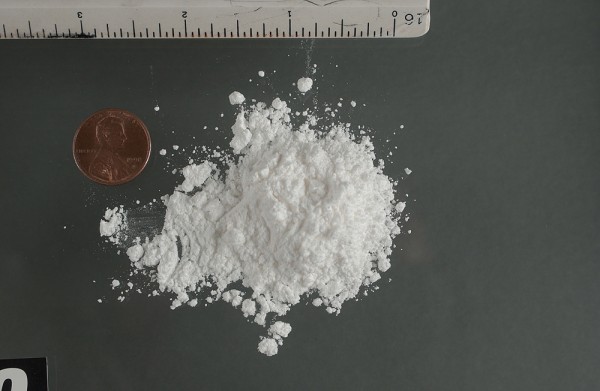 From 1986 until 2010, the punishment for possessing cleft, a "poor person'south drug," was 100 times stricter than the penalty for cocaine utilise, a drug favored by the wealthy. (Photo courtesy of Wikimedia Commons)
This imbalance based on class power is also found within U.South. criminal police. In the 1980s, the use of crack cocaine (cocaine in its purest class) apace became an epidemic that swept the country'southward poorest urban communities. Its pricier counterpart, cocaine, was associated with upscale users and was a drug of option for the wealthy. The legal implications of being caught past authorities with scissure versus cocaine were starkly different. In 1986, federal police mandated that being caught in possession of 50 grams of crack was punishable by a ten-twelvemonth prison sentence. An equivalent prison sentence for cocaine possession, yet, required possession of v,000 grams. In other words, the sentencing disparity was 1 to 100 (New York Times Editorial Staff 2011). This inequality in the severity of penalisation for crack versus cocaine paralleled the unequal social course of respective users. A disharmonize theorist would annotation that those in society who concord the power are also the ones who brand the laws concerning crime. In doing then, they make laws that will benefit them, while the powerless classes who lack the resources to make such decisions endure the consequences. The crevice-cocaine punishment disparity remained until 2010, when President Obama signed the Fair Sentencing Act, which decreased the disparity to 1 to 18 (The Sentencing Project 2010).
Feminist Theory and Deviance
Women who are regarded as criminally deviant are often seen as existence doubly deviant. They take broken the laws but they take as well broken gender norms near appropriate female behaviour, whereas men's criminal behaviour is seen as consistent with their aggressive, self-assertive character. This double standard likewise explains the tendency to medicalize women's deviance, to see it as the product of physiological or psychiatric pathology. For example, in the late 19th century, kleptomania was a diagnosis used in legal defences that linked an extreme desire for department store commodities with diverse forms of female physiological or psychiatric affliction. The fact that "proficient" center- and upper-class women, who were at that time coincidentally beginning to experience the benefits of independence from men, would turn to stealing in department stores to obtain the new feminine consumer items on display there, could not be explained without resorting to diagnosing the action as an illness of the "weaker" sex activity (Kramar 2011).Feminist assay focuses on the way gender inequality influences the opportunities to commit crime and the definition, detection, and prosecution of crime. In role the gender divergence revolves around patriarchal attitudes toward women and the condone for matters considered to be of a private or domestic nature. For example, until 1969, abortion was illegal in Canada, meaning that hundreds of women died or were injured each year when they received illegal abortions (McLaren and McLaren 1997). Information technology was non until the Supreme Court ruling in 1988 that struck down the constabulary that it was acknowledged that women are capable of making their ain selection, in consultation with a doctor, about the procedure. Similarly, until the 1970s, two major types of criminal deviance were largely ignored or were difficult to prosecute as crimes: sexual attack and spousal set on.
Through the 1970s, women worked to alter the criminal justice arrangement and establish rape crisis centres and battered women'due south shelters, bringing attention to domestic violence. In 1983 the Criminal Code was amended to replace the crimes of rape and indecent set on with a three-tier structure of sexual assault (ranging from unwanted sexual touching that violates the integrity of the victim to sexual set on with a weapon or threats or causing actual harm to aggravated sexual attack that results in wounding, maiming, disfiguring, or endangering the life of the victim) (Kong et al. 2003). Johnson (1996) reported that in the mid-1990s, when violence against women began to be surveyed systematically in Canada, 51 percent of Canadian women had been the subject to at to the lowest degree i sexual or physical assault since the age of 16.
The goal of the amendments was to emphasize that sexual attack is an act of violence, non a sexual act. Previously, rape had been divers every bit an act that involved penetration and was perpetrated against a woman who was non the married woman of the accused. This had excluded spousal sexual assault equally a law-breaking and had also exposed women to secondary victimization by the criminal justice system when they tried to bring charges. Secondary victimization occurs when the women'due south own sexual history and her willingness to consent are questioned in the process of laying charges and reaching a confidence, which as feminists pointed out, increased victims' reluctance to lay charges.
In particular feminists challenged the twin myths of rape that were oftentimes the subtext of criminal justice proceedings presided over largely by men (Kramar 2011). The offset myth is that women are untrustworthy and tend to lie about assault out of malice toward men, as a style of getting dorsum at them for personal grievances. The 2nd myth, is that women volition say "no" to sexual relations when they really mean "aye." Typical of these types of issues was the approximate's comment in a Manitoba Court of Entreatment case in which a man plead guilty to sexually assaulting his twelve- or thirteen-twelvemonth-erstwhile bodyguard:
The girl, of course, could not consent in the legal sense, but still was a willing participant. She was apparently more sophisticated than many her age and was performing many household tasks including babysitting the accused's children. The accused and his wife were somewhat estranged (cited in Kramar 2011).Because the daughter was willing to perform household chores in identify of the man's estranged wife, the estimate assumed she was too willing to engage in sexual relations. In order to address these types of event, feminists successfully pressed the Supreme Courtroom to deliver rulings that restricted a defence attorney'southward access to a victim'south medical and counselling records and rules of prove were changed to foreclose a woman's past sexual history being used against her. Consent to sexual discourse was redefined as what a woman actually says or does, not what the man believes to be consent. Feminists likewise argued that spousal assault was a key component of patriarchal power. Typically it was hidden in the household and largely regarded as a private, domestic matter in which police force were reluctant to get involved.
Interestingly women and men report similar rates of spousal violence—in 2009, vi per centum had experienced spousal violence in the previous five years—but women are more likely to experience more severe forms of violence including multiple victimizations and violence leading to physical injury (Sinha 2013). In order to empower women, feminists pressed lawmakers to develop zero-tolerance policies that would support aggressive policing and prosecution of offenders. These policies oblige police to lay charges in cases of domestic violence when a complaint is fabricated, whether or non the victim wished to proceed with charges (Kramar 2011).
In 2009, 84 percentage of violent spousal incidents reported by women to police resulted in charges being laid. However, according to victimization surveys only xxx percent of actual incidents were reported to police. The majority of women who did non report incidents to the police force stated that they dealt with them in another way, felt they were a individual matter, or did non think the incidents were of import enough to report. A significant proportion, notwithstanding, did not desire anyone to find out (44 percent), did not want their spouse to be arrested (40 percentage), or were likewise afraid of their spouse (nineteen percent) (Sinha 2013).
Further Research
The Skull and Bones Society fabricated news in 2004 when it was revealed that then-President George W. Bush and his Democratic challenger, John Kerry, had both been members at Yale University. In the years since, conspiracy theorists accept linked the secret guild to numerous world events, arguing that many of the nation's most powerful people are former Bonesmen. Although such ideas may heighten a lot of skepticism, many influential people of the by century have been Skull and Bones Social club members, and the society is sometimes described as a higher version of the power aristocracy. Journalist Rebecca Leung discusses the roots of the gild and the impact its ties between decision-makers can have afterwards in life. Read most it here.
Call up It Over
- Pick a famous politician, business organisation leader, or celebrity who has been arrested recently. What crime did he or she allegedly commit? Who was the victim? Explain his or her actions from the signal of view of i of the major sociological paradigms. What factors best explain how this person might exist punished if convicted of the law-breaking?
- If we presume that the ability aristocracy'south status is always passed down from generation to generation, how would Edwin Sutherland explain these patterns of ability through differential clan theory? What crimes exercise these aristocracy few get abroad with?
Practice
1. Co-ordinate to C. Wright Mills, which of the post-obit people is most probable to exist a member of the ability elite?
- A war veteran
- A senator
- A professor
- A mechanic
2. Co-ordinate to the concept of the power aristocracy, why would a celebrity such equally Charlie Sheen commit a criminal offense?
- Because his parents committed similar crimes
- Because his fame protects him from retribution
- Because his fame disconnects him from society
- Because he is challenging socially accepted norms
Show Glossary
Licenses and Attributions
Source: https://www.coursehero.com/study-guides/alamo-sociology/reading-conflict-theory-and-deviance/
Posted by: jorgensenknort1985.blogspot.com
0 Response to "How Do Conflict Theorists Explain The Makeup Of Prisoners In The U.s. Prison System?"
Post a Comment